Financial advisors ranked dead last in AI adoption. Here's how fast that changed, and what's still missing
A few years into AI's rise across every industry, most financial advisors have adopted some kind of tool. But how far has that adoption actually taken them?
In 2023, a University of Chicago study examined generative AI usage across 11 professions. Financial advisors ranked lowest, both at work and at home.
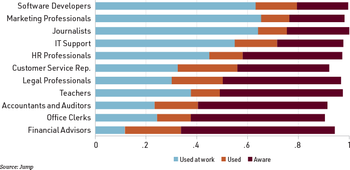
Source: Case Study: AI Redefines the Advisor Workday | Investments & Wealth
Back then, there were few if any compliant AI tools built for how advisors and financial professionals actually work. But that's changed fast. As of early 2026, 70% of billion-dollar RIAs use AI for notetaking or call documentation. And the AI titans of the world are waking up to financial services as a viable market: in mid-September, Anthropic and OpenAI both announced tools and integrations targeting financial advisors. Public interest in Model Context Protocol (MCP), the standard which allows software to connect with AI tools, spiked in the spring of 2026 as more and more software brands – including in fintech – announced integrations with LLMs.
A new report from Jump shows that the rapid expansion of AI capability is unlocking new use cases and business impact. Using AI for basic tasks like notetaking or CRM updates is just the beginning of AI maturity.
The AI Maturity Model for Enterprise Wealth Management lays out four stages of AI maturity: Experimental, Operational, Strategic, and Transformational. Maturity is measured across six dimensions, including AI capability, specialization, compliance and governance, tech stack integration, adoption, and business outcomes, because a firm can be advanced on one and still early on another.
"I would say at this point, almost everybody has at least experimented with some kind of chatbot," says Jump CEO Parker Ence. "I think we're just at the top of the first inning here with what AI is going to eventually do."
What’s still missing
Using chatbots or widely available LLMs would put advisors in the "experimental" stage. With the proliferation of AI tools purpose-built for financial services, more and more firms are crystallizing their AI strategies and seeing improved business outcomes – like increased productivity and better client experience. Advisors find themselves at a variety of AI maturity stages.
"I'd call myself AI-aware, but nowhere close to AI-native," says Drew Boyer, CFP®, drawing a comparison to having a great idea for a business but being unsure where to actually start it. Boyer uses a purpose-built AI system for financial services that syncs directly to his CRM.
Danielle Darling, CDFA®, says she feels further ahead in making AI part of the actual client-service workflow rather than treating it as a standalone tool. "I've tried to build a connected tech stack where AI helps me take a client conversation and turn it into action," she says. The payoff shows up in how she spends her time.
"Those hours go back into client conversations, proactive outreach, business development, and continuing to grow the practice while still maintaining a high-touch client experience," she says.
If advisors are seeing the benefits, so too are their clients. But the advisors furthest along are also the clearest-eyed about how much runway is left. In the grand scheme, AI in wealth management is still early.
"Where I still feel behind is true end-to-end automation," Darling says. "I use AI throughout my workflow, but I'm not yet at the point where autonomous agents are running entire processes without my involvement. There are still places where I'm reviewing outputs, moving information between systems, or initiating the next step myself."
Sarah Cicero, CFP® and CFA highlighted the same shortfall from a firm-wide angle, saying, "Where we have more work to do is connecting workflows across our systems and reducing manual handoffs."
That connection of workflows is where the impact of AI begins to compound. The Jump AI Maturity Model details that firms at the "transformational stage" – when AI runs as one connected, firm-wide system – are able to leverage years of client relationships to make better business decisions and gain a competitive edge.
What’s next for firms after quick AI wins
In its earliest stages, AI delivered a number of quick wins–meetings summarized, CRM notes updated, hours saved. Further along, the payoff is process automation and advisor effectiveness, boosting core metrics like organic AUM growth, net new assets, and revenue per advisor. Full AI transformation elevates human performance enterprise-wide, reshaping the firm's operating model, economics, and competitive position rather than just its workflows.
Even advisors early in that journey are already seeing the benefits.
"Growth isn't always AI directly handing you a referral," Darling says. "Sometimes AI creates the capacity that allows you to take on more relationships and still deliver a high-touch client experience."
But the pressure to keep climbing is real.
"I've traditionally been a late adopter," Boyer says. But the race to being fully transformational with AI has galvanized him. "This time, I don't want to be the guy still holding a BlackBerry when everyone else has already switched to the iPhone. I want to get ahead of this curve, not catch up to it."