From Efficiency to Effectiveness: What Comes After AI Notetaking?
AI has already proven its value in wealth management, particularly when it comes to helping financial advisors save time on administrative tasks. Adoption is increasingly widespread: By early 2026, Cerulli Associates reported that 70% of billion-dollar RIAs use AI for notetaking or call documentation.
But as Jump’s AI Maturity Model illustrates, there’s a difference between using AI to complete individual tasks more efficiently and using it to fundamentally improve how advisors work, serve clients, and grow their businesses.
Efficiency is only the beginning
AI’s most immediate benefit for advisors is efficiency. Kitces research found that in 2018, advisors spent only about 17% of their week meeting with clients, with administrative work taking much of the rest. AI meeting assistants that prepare briefs, capture notes, draft recap emails, and update the CRM help advisors reclaim time they’d otherwise spend on admin work, with some advisors reporting savings of 10+ hours per week.
Advisors put that time to work. 80% of surveyed advisors said they reinvest the time they regain in revenue-producing activities, including client meetings, prospecting, and relationship-building.
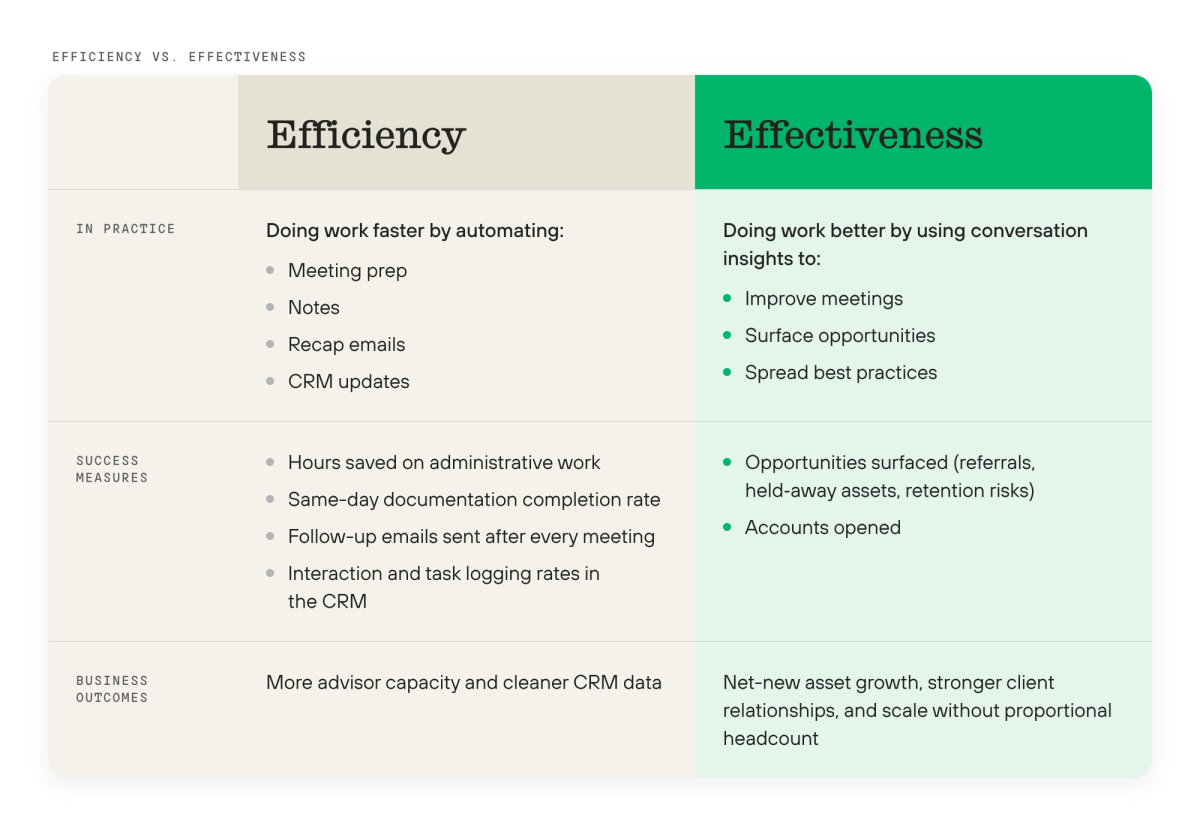
Because regained time goes to client-facing work, the next step is to improve that work: the meetings themselves, the insights advisors bring to them, and the outcomes that follow. This is the shift from AI for efficiency to AI for effectiveness. Efficiency is about doing work faster; effectiveness is about doing it better. Rather than measuring success from productivity gains, like meetings recorded and emails drafted, firms must start measuring business outcomes like opportunities surfaced and accounts opened.
Increasing effectiveness with conversational intelligence
A major driver of effectiveness is conversational intelligence, which draws insights from the content of advisor-client conversations, such as topics, sentiment, and objections. Those insights improve the quality and consistency of advisors’ work and surface opportunities advisors might otherwise miss.
Measuring what top advisors do differently
Advisors encounter many of the same situations throughout their careers: hesitant prospects, fee objections, clients considering a change, and opportunities to expand a relationship. Across a large firm, similar conversations have likely happened thousands of times, yet the best approaches usually stay with the advisors who developed them.
By analyzing that accumulated conversational data, AI can show what the firm’s strongest advisors do differently. In referral conversations, for example, advisors with the highest conversion rates might respond quickly, acknowledge who made the introduction, and suggest a low-commitment first step like a quick introductory call. These approaches then become evidence-based playbooks that every advisor can apply in future conversations, so the firm’s best work scales to every client.
Conversational intelligence across the meeting cycle
Conversational intelligence makes advisors more effective before, during, and after each meeting. Before a meeting, briefs built from prior conversations suggest opportunities and recommended approaches. During the meeting, AI surfaces timely prompts, such as a missed agenda item or a shift in client sentiment. In the background, AI agents can start workflows based on the discussion, such as preparing account-opening or asset-rollover documentation from connected systems. Afterward, advisors review AI-generated feedback and see where future conversations can improve.
By drawing on conversations, client records, and other connected systems, this support carries through the whole workday and drives the business outcomes below.
Measuring business growth
Firms can track outcomes such as net-new assets, referrals received and converted, held-away assets identified and consolidated, at-risk clients retained, and accounts opened. Grow’s net-new asset funnel, for example, follows a held-away asset from the moment a client mentions it, to a consolidation suggestion, to client agreement.
In a Jump test with a top-three independent broker-dealer, advisors with access to Jump saw 2.1x more net-new asset growth than a comparison group matched on prior-year growth.
How to move from efficiency to effectiveness
Firms that have already gained efficiency can take several practical steps toward effectiveness. Each one builds on conversations the firm is already capturing. Jump Grow turns those conversations into revenue intelligence, surfacing growth opportunities, tracking client sentiment, and helping firms measure results like referrals and net-new assets.
- Get firm-level answers from every client conversation: Leaders can define what they want to know about client conversations and advisor performance, such as which topics clients raise most often, and have answers extracted automatically from each new meeting. With Pulse, leaders get structured results they can compare across teams over time, replacing survey responses and anecdotes.
- Surface opportunities: Clients mention referrals, held-away assets, and life events in conversation, often in passing. Signals detect these moments so advisors can follow up while interest is high.
- Turn top performers’ habits into repeatable practice: Playbooks turn the practices of the firm’s strongest advisors into workflows other advisors can follow, and Scorecards measure how consistently advisors apply those practices.
- Give every advisor feedback on real meetings: Many advisors have no one to review their client conversations with them. Coaching gives advisors feedback after each meeting on what went well and what to improve, and highlights three focus areas to bring into the next conversation. In the Insights tab, advisors can see patterns across recent meetings and track progress over time, with links back to the meetings behind each insight.
Find where your firm stands on AI maturity
Firms that have gained efficiency have made an important start, and the move from efficiency to effectiveness is a large part of becoming AI mature. AI-mature firms create capacity without growing headcount in proportion, and they change how they grow, govern, and compete, which positions them to win clients and talent.
Jump’s AI Maturity Model for Enterprise Wealth Management maps this progression. It places firms on one of four stages, from Experimental to Transformational, and measures each across six dimensions, including AI capability, compliance and governance, and business outcomes. On business outcomes, firms at the Operational stage gain efficiency, firms at the Strategic stage gain effectiveness by surfacing and scaling the practices that drive growth, and firms at the Transformational stage build a competitive advantage across the entire business.