How Real Advisors Use Jump to Become Better Communicators
A financial advisor's role isn't only about money. Beyond technical advice on investing or building a nest egg, advisors are often listening for the emotions behind a client's goals.
Advisors using Jump have tools to help them be more perceptive. Instead of wondering if they talked too much or missed something important, they use meeting analytics, summaries, and transcripts to get a clear view of their own communication style, sharpening how they listen and staying focused on what matters most to clients.
Key takeaways:
- AI Associate surfaces what clients actually said, keeping recommendations grounded in stated priorities instead of assumptions.
- The Insights Dashboard gives advisors and teams a clear read on talk-time balance, turning gut feelings about a meeting into measurable coaching moments.
- Notetaker captures the technical details automatically, so advisors stay fully present with clients, picking up on tone and emotion instead of dividing attention between note-taking and listening.
Listening for What Actually Matters
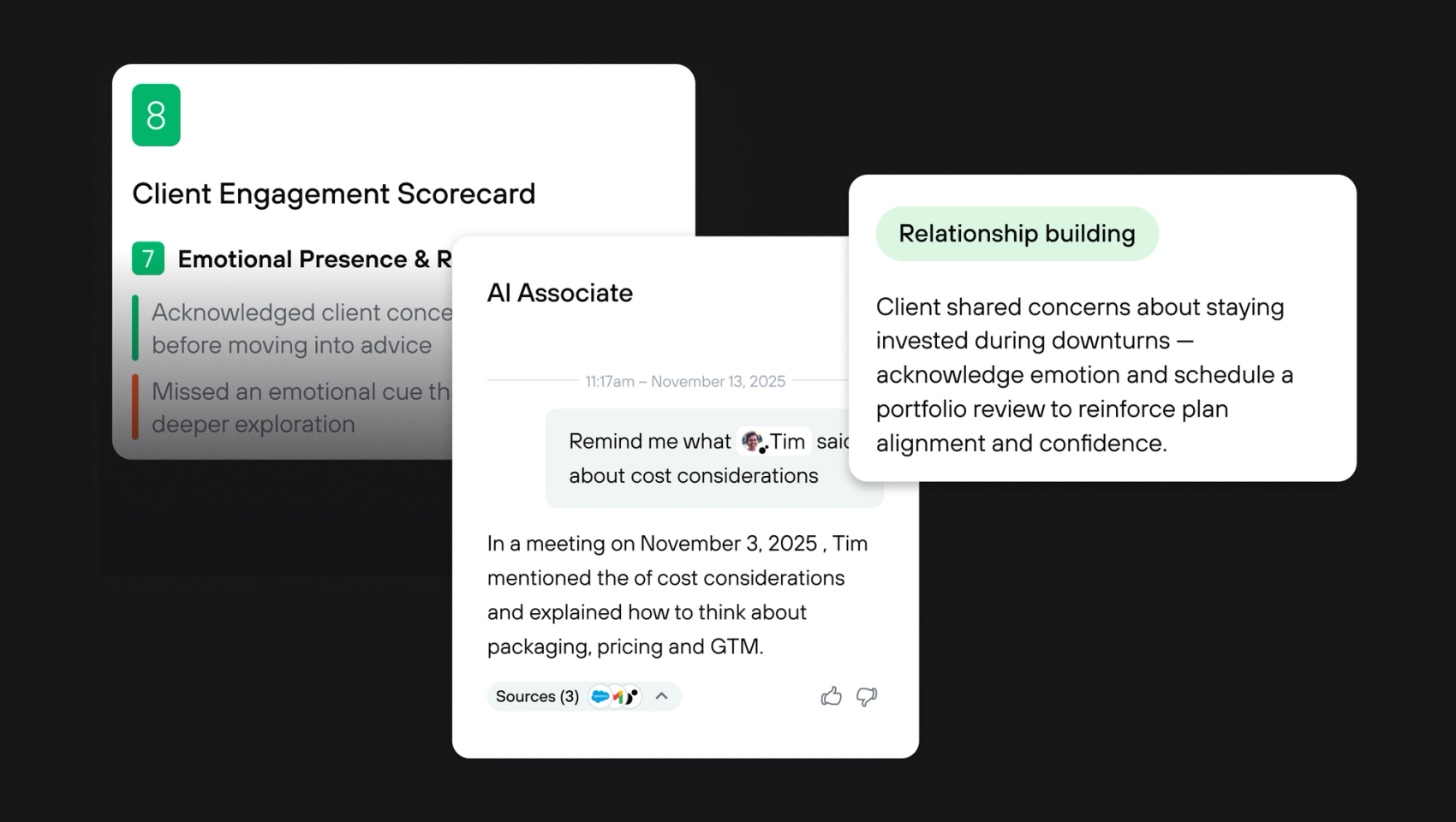
Danielle Darling, CDFA®, financial advisor at Darling Wealth Management, knew what her client wanted, or at least she thought she did. After a meeting, her recommendations were clear: prioritize an emergency fund and then pay down high-interest credit card debt before funding a 529 plan. She would have followed that path, until she prompted Jump’s AI Associate to summarize the client’s priorities based on their conversation.
What she found saved her time and the client’s goodwill.
“I asked Jump to summarize the client’s top priorities and realized they were different from the priorities I thought they should have,” Darling said. “The client strongly preferred funding the 529 first, even after we discussed the tradeoffs and risks of not focusing on the emergency fund.”
Seeing her client’s expressed desires laid out so clearly reminded Darling that her role didn’t involve convincing clients to adopt her priorities; she needed to help them achieve their goals. Using Jump keeps her aligned with what her clients actually want.
“One of my favorite Jump features is AI Associate because it helps me verify what clients actually said and what mattered most to them,” Darling said.
After this experience, Darling now leads her meeting recap emails with each client’s stated priorities before sharing her own recommendations. She finds that this approach helps her deliver more responsive client service.
“Jump has made me a better listener, a better communicator, and has helped me ensure clients feel heard while still documenting the advice I provide,” she said.
Who’s doing the talking?
The gift of gab can be useful for a financial advisor. However, if they talk too much and miss key details, that gift can quickly become a liability.
To improve communication, Matthew Koppelman, CFP® and his team at Precision Wealth Planners use Jump analytics about once a month. The User talk time vs Client talk time chart in Jump Insights Dashboard allows them to see what % of call time advisors vs. clients are actively speaking. If an advisor dominates introductory meetings, it may signal a need to work on active listening. Kevin Christensen, CFP®, founder of Aligned Financial Planning, also uses talk time data to guide how he approaches meetings with clients and prospects. Ideally, he aims for the client to speak more than half the time, though depending on the situation, that ratio may shift.
Koppelman likens his use of Jump to a coach watching film of developing players. Like a good coach, he uses the insights Jump provides to offer guidance that helps his team improve how they run meetings.
“Having the transcript and video to rewatch helps identify what made the meeting successful or not,” Koppelman said.
His team also uses transcripts to sharpen their instincts about how a meeting went and what could be improved next time. With Jump, gut feelings can become actionable insights.
Slowing Down to Meet the Moment
Financial advisors often meet clients during some of the most difficult moments of their lives. Being emotionally present and listening with care in these situations is essential for building trust.
That’s the position Sarah Cicero, CFP®, CPA, financial advisor at StoneBridge Advisors, found herself in when meeting with a woman who had just lost her husband who had been the primary financial decision-maker. In the middle of grief, she was forced to make overwhelming financial decisions in unfamiliar territory.
The moment called for Cicero to navigate the situation with empathy and expertise. Fortunately, Cicero was already using Jump. Because the AI notetaker captured the technical aspects of the conversation, she could focus fully on the client in front of her, picking up on tone, uncertainty, and moments of overwhelm.
“There were important and time-sensitive planning issues to address, but the meeting could not be treated solely as a financial checklist,” Cicero said. “Because Jump captured the facts, questions, and follow-up items, I didn’t have to divide my attention between taking detailed notes and watching how she was responding.”
Reviewing meeting summaries and transcripts later, Cicero noticed a pattern: she sometimes moved too quickly from hearing a client’s concerns into problem-solving mode.
“I began to notice moments when a client made an emotional or personal comment and I moved relatively quickly into facts, recommendations, or next steps,” she said. “The information I provided was appropriate, but the client may have benefited from an additional pause, acknowledgment, or open-ended question before we moved into planning.”
Cicero now makes a conscious effort to pause after emotional moments, acknowledge what she’s heard, ask open-ended questions, and avoid overwhelming clients with too much information at once. She also ends meetings with clear, manageable next steps to help clients feel more confident moving forward.
Finding Balance in Real Time
Wanting a clearer picture of his own talk time, Drew Boyer, CFP®, founder of Boyer Financial Group, turned to Jump. What he discovered was surprisingly precise: his most successful meetings happen when he speaks about as much as he listens. He now thinks of Jump as an "internal timer" that helps him stay aware of that balance in real time. "Jump has not only made me a better advisor who listens more but is also getting better outcomes for my clients, where each side of the table feels heard," Boyer said.
Those better outcomes are reflected in satisfied clients, like a couple who left a meeting with Boyer committed to a complex estate planning strategy that gave them a greater sense of security.
- Try Jump free for 14 days
- Get a demo