AI notetakers for financial advisors: generic vs. purpose-built tools

by Jump
Of all the onerous tasks to outsource to AI, taking notes during meetings is probably one of the ones most financial advisors are happy to let go of.
Handing it off helps advisors save time and stay focused on the conversation. In the end, most AI notetakers will serve up a decent transcript and summary, which makes the workflows that follow a little bit easier. No surprise, then, that notetaking capabilities are now included with the most popular conferencing tools, with dedicated notetakers also rising in popularity.
But for advisors, purpose-built AI notetakers can have wide-reaching benefits, from increased efficiency to greater effectiveness to better regulatory compliance. These tools need to be compliant while handling industry-specific note formats and CRM and planning updates. Though generic notetakers can be broadly useful, only tools purpose-built for financial services truly fit advisors’ specific workflows before, during, and after the meeting.
Key takeaways
- Generic AI notetakers produce transcripts and summaries, but financial firms also need compliant records and structured data.
- Specialized notetakers are tailored to financial services workflows through compliance controls, domain understanding, and tech stack integration.
- A specialized notetaker may cost more, and Jump returns that investment in saved time and business growth, backed by compliance controls, 40+ integrations, and white-glove support.
What is an AI notetaker purpose built for financial advisors, and how does it differ from a generic one?
Specialized AI notetakers for financial advisors are built for the regulations, vocabulary, and workflows of financial services. Generic AI notetakers, which can be built into conferencing tools like Zoom or Teams, or work as third-party add-ons, are built to work for any market, but pose risks for advisors. Though many generic tools can now produce outputs like transcripts, summaries, and follow-up items, financial firms also need compliant records for regulators and structured data for client service, which generic tools are not built to provide.
3 ways specialized AI notetakers support financial advisor workflows
Notetakers built for financial services workflows are tailored in three ways: compliance controls, domain understanding, and tech stack integration.
Compliance controls
Compliance is a high priority for financial firms. Compliant AI notetakers must account for how capture, consent, retention, and archiving fit the regulated workflow.
- Capture and consent: A specialized notetaker lets the firm choose how meetings are captured and how client consent is recorded, while a generic tool applies one default across every industry. Jump supports no-recording capture or compliant recording, with consent configured by the firm.
- Retention and archiving: A specialized notetaker allows financial firms to set retention and archiving to match financial recordkeeping and supervision requirements, and generic settings can conflict with them. Jump lets firms configure retention and archiving to their own policy.
- Regulatory exposure: Use of nonprovisioned notetaking tools can lead to trouble with regulators and erode client trust. Meeting records created outside the firm’s approved systems fall outside its books-and-records and supervision processes, so the firm may be unable to review or produce them when a regulator or compliance team asks.
Domain understanding
Generic tools don’t support workflows tailored to financial advisors. Advisors need tools that know financial services concepts and formats, so outputs reflect how advisors run meetings.
- Meeting context: A specialized notetaker recognizes meeting types such as prospecting vs. client review, while a generic tool treats them as ordinary conversation. Jump is built around advisor workflows, so it adapts to the type of meeting.
- Note output: A specialized notetaker writes notes in financial services formats, while a generic tool uses general templates, requiring advisors to go back and revise financial details and meeting context manually. Jump produces notes in these formats, which means less time correcting output.
- Insights: A specialized notetaker reads client conversations for firmwide insights such as unmet planning needs and held-away assets, while generic tools lack the industry context to surface them. Jump surfaces these signals along with referral intent and sentiment shifts.
- Customization: A vendor focused on financial services is more likely to build the templates, features, and configurations a firm needs than a video conferencing or phone platform built for every industry. Jump works with firms to customize note templates and configure the platform to their needs.
Tech stack integration
Generic notetakers, whether standalone or included in existing conferencing tools, typically offer limited CRM integrations and do not connect to financial planning, portfolio management, or custodian platforms, so the work continues manually.
- Connected systems: A specialized notetaker syncs in both directions with the CRM, financial planning, portfolio management, and custodian platforms. Jump has 40+ integrations, including Claude, Salesforce, eMoney, and Orion.
- Before the meeting: A specialized notetaker reads data from those systems for meeting prep. Jump builds pre-meeting prep from the CRM, planning, and email.
- After the meeting: A generic tool typically stops at the summary and action items, while a specialized notetaker writes structured updates back to the systems. Jump pushes updates to the CRM and planning tools and drafts the follow-up.
Why use Jump?
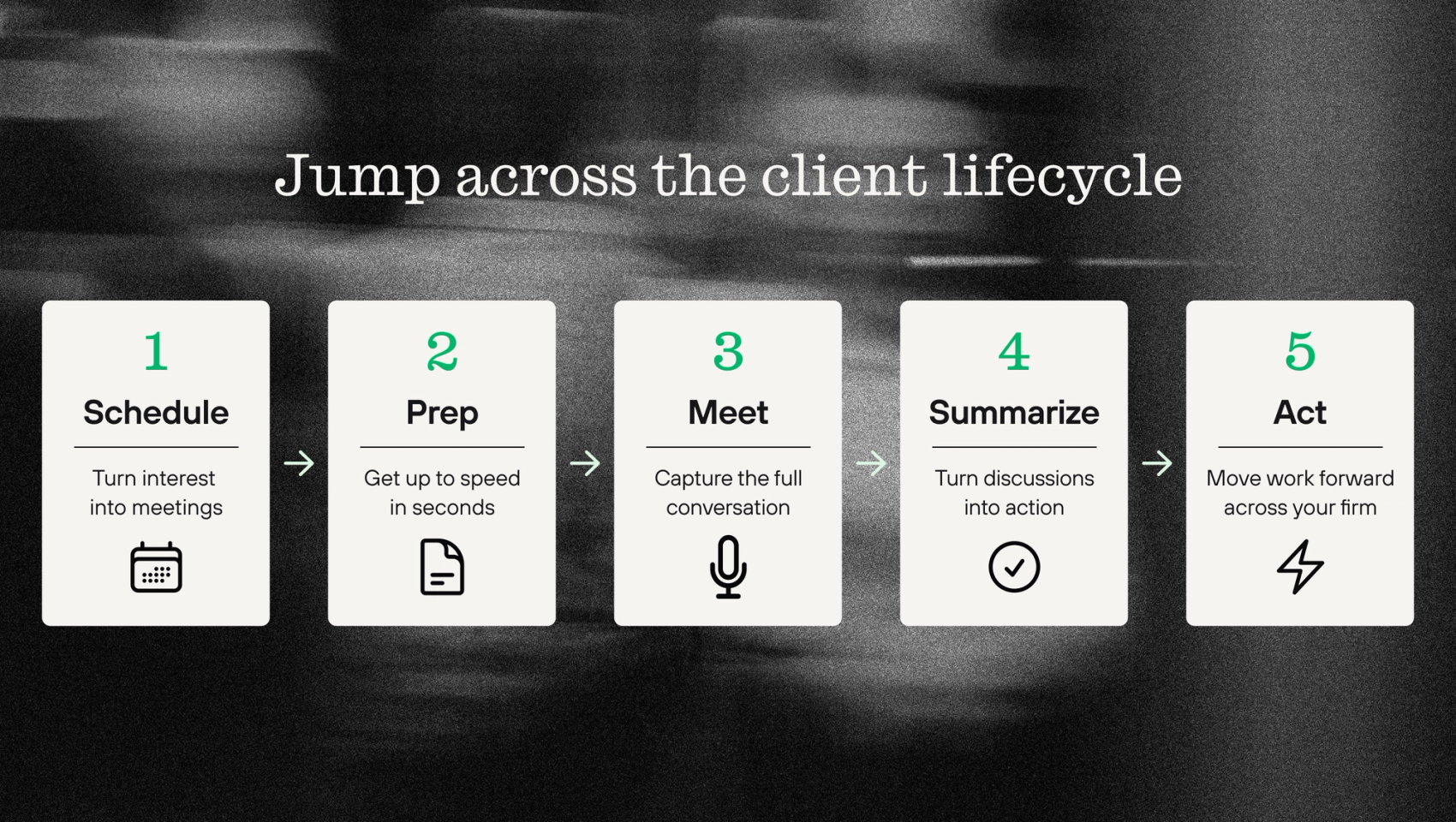
While many notetaking tools are free or bundled with platforms firms already pay for, they come with tradeoffs for financial professionals. Their compliance controls are built for any industry and may not meet financial recordkeeping and supervision requirements, which can put client data, credibility, and audit trails at risk. A lack of specificity around financial workflows means manual reworking and adjusting. Many generic tools stop at the summary, leaving CRM updates and follow-up to be done by hand. A specialized notetaker may cost more, but the return shows up in saved time and business growth.
Jump is the AI platform built for advisors and financial professionals, with products that cover the full client lifecycle. Three foundations support adoption at scale:
- Compliance and security: SOC 2 Type II, zero-day retention available, and no training on client data.
- Adoption: sustained use across firm sizes, with white-glove support from a US-based account team.
- Integrations: the #1 wealthtech integration score in its category, per Ezra Group.
Those foundations show up as return in four places:
Time: 10+ hours reclaimed per week, with post-meeting work finished in minutes.
Growth: held-away asset, consolidation, and referral signals that support growth in assets under management (AUM).
Client relationships: sentiment shifts surfaced from client conversations, so advisors can act on them sooner.
Compliance confidence: controls set to firm policy and audit-ready records on demand.
Jump Grow analyzes analyzes client conversations to surface signals and trends and to score advisor performance for coaching.
Choosing the right AI notetaker for your firm
AI notetakers are fast-growing, standard in modern workplaces, and easy to adopt. But the one-size-fits-all approach of generic tools poses more risk than benefits. Specialized AI notetakers deliver compliance controls set to firm policy, notes in financial services formats, and structured updates that flow directly into the CRM.
Firms comparing platforms can use Jump’s free buyer’s guide, Seven Requirements for Choosing an AI Platform in Wealth Management, to evaluate each option on security and compliance, architecture, and ROI, with specific metrics for every requirement.
Jump Meet supports the time before, during, and after every meeting. It helps financial professionals save hours every week, grow AUM, and deepen client relationships while keeping firms compliant amid changing regulatory requirements.
Learn more about Jump